








The future of healthcare isn’t on the horizon—it’s already here and accelerating quickly. For independent physician groups, the pressure to adapt is mounting. From generative AI to shifting reimbursement models and increasing patient demand for personalized care, the path forward can feel overwhelming. But here’s the truth: the most successful organizations in 2025 will be those whose strategies are rooted in real-world insight and aligned with the most urgent 2025 healthcare trends.
At VBC Transformation Partners, we bring clarity to the chaos. Grounded in clinical leadership and proven operational results, we help healthcare organizations cut through the noise and confidently build what’s next.
Strategic Alignment in a Time of Disruption: Why 2025 Healthcare Trends Demand Action
Many of you are facing a daunting question: How do we stay competitive, sustainable, and centered on care in a system that’s evolving faster than ever? Whether you're grappling with declining reimbursements, a burned-out workforce, or the pressure to integrate AI without disrupting workflows, the need for a clear, future-ready strategic plan has never been greater. The key lies in aligning that plan with the latest healthcare trends, which are already reshaping care delivery, payment models, and operational strategy.
From Medicare reimbursement cuts of 2.93% to rising overhead and staffing shortages, providers are being squeezed on all sides (KSM, 2025). We understand how exhausting it is to feel like you're constantly being asked to do more with less—and how hard it is to plan strategically when the rules keep changing.
At the same time, AI, value-based contracts, and digital care models are transforming how care is delivered and paid for (PwC, 2025; Philips, 2025). It's no longer a question of if you should adapt—but how. If you're feeling unsure about where to start—or worried you'll be left behind—we want you to know: you're not alone, and you're not too late.
The VBC Transformation Advantage: Real Strategy, Real Results
At VBC Transformation Partners, we help physician groups bridge the gap between insight and execution. Our personalized, physician-led approach equips your organization to:
Improve Financial Performance: We’ve helped clients cut costs by up to 30%, increase revenue by 15%, and save millions through smarter risk models and care redesign.
Reduce Burnout: Streamlined workflows and smart documentation systems have reduced operational strain while restoring clinical autonomy.
Optimize Care Delivery: By aligning quality measures with workflows and EHR systems, we’ve driven improvements in Stars ratings, chronic disease outcomes, and patient satisfaction.
We don’t just talk transformation—we build it with you. We meet you where you are, help you find the right path forward, and walk with you every step of the way. We want to be your transformation partner—and our case studies show exactly what that looks like in action.
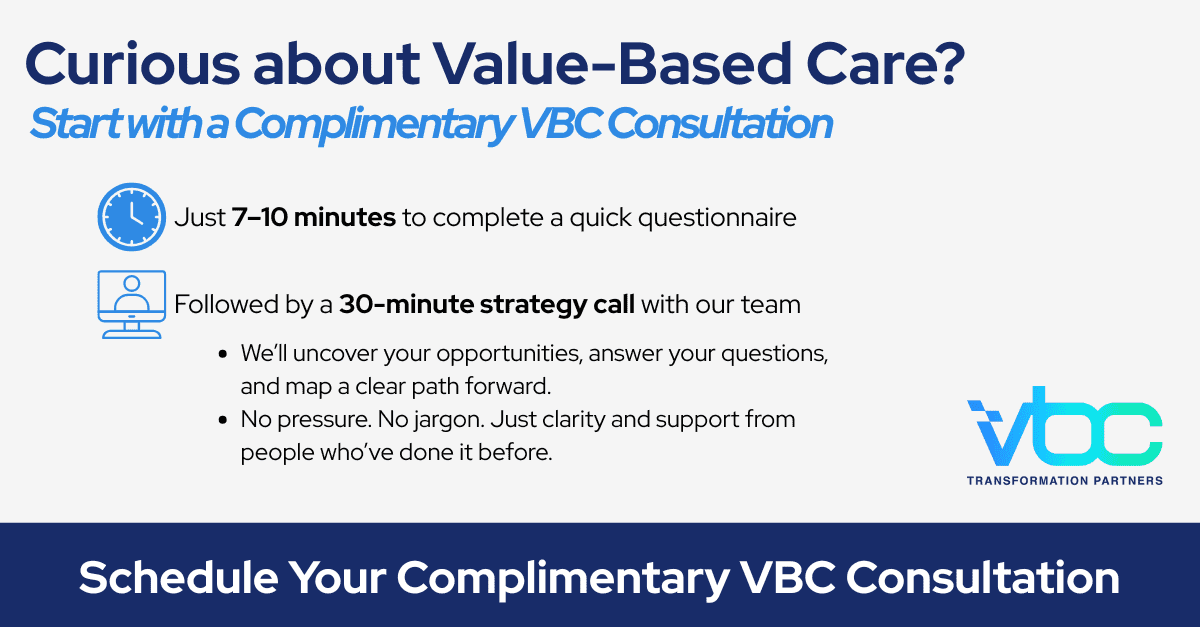
Let’s take a closer look at the key 2025 healthcare trends shaping the future—and how they’re influencing the path forward for independent physician groups.
Trend #1: AI is Here—But it Needs Strategy to Work Well
2025 isn’t about dabbling in AI—it’s about integrating it intelligently. Nearly 77% of healthcare executives rank AI as a top investment priority (PwC, 2025). From clinical note generation to predictive scheduling, AI is now central to workflow optimization.
Here’s the catch, though: there’s a wide gap between investment and implementation. Used strategically, AI can automate documentation, streamline prior authorizations, enhance scheduling, and improve diagnostics—helping providers gain back precious time and reduce burnout. Deloitte notes that AI tools could save nurses 240–400 hours per year by offloading administrative work. Yet, many systems still view AI as a “plug-and-play” solution, when in reality, it requires careful workflow integration, trust-building with clinical teams, and measurable outcomes.
At VBC Transformation Partners, we help organizations lay the groundwork for AI integration by aligning their strategic goals, staffing models, and documentation workflows. While we don’t sell AI products, we support teams in identifying high-impact pilot areas, preparing for adoption, and ensuring any technology investment enhances—not disrupts—care delivery. Whether you’re just beginning to explore automation or already testing new tools, we help you ask the right questions, measure what matters, and build a path to long-term value. We know that with the right strategy, AI investment can support your people—and your outcomes.
“Generative AI has emerged as a powerful tool… promising to boost clinician productivity in ways that seemed impossible just a few years ago.” —Philips
Trend #2: The Value-Based Shift is Accelerating
The transition to value-based care is no longer just a policy trend—it’s a business imperative. CMS continues to push forward with expanding risk-based contracts, and commercial payers are following suit. For independent physician groups, this shift presents both an opportunity and a challenge: how to move toward risk and outcomes-based payments without overwhelming your clinical and administrative teams.
As Capella University notes, this shift means moving away from fee-for-service toward models like bundled payments, capitation, and shared savings arrangements that reward outcomes rather than volume. Yet many organizations remain hesitant, unsure how to operationalize these models or how to thrive within them (KSM, 2025).
That’s where VBC Transformation Partners comes in. We don’t just explain value-based care—we help you pilot it. Our approach begins by understanding your current payment mix, clinical model, and readiness for change. We build realistic roadmaps that help you enter risk gradually, with support at every step. From documentation advisory and revenue integrity to pro forma modeling and care redesign, we provide the infrastructure that makes success possible.
We set our sights on demystifying value-based care and helping you make real progress—no big tech spend, no buzzwords. The results aren’t just about cost containment—they’re about empowering providers to deliver the kind of proactive, high-quality care they’ve always wanted to provide.
“More payers are moving away from the traditional fee-for-service model, which reimburses providers for each service, and shifting toward value-based care models that reward better outcomes and lower costs.” —Capella University
Trend #3: Workforce Burnout is a Strategic Risk—and a Transformation Opportunity
Workforce burnout isn’t a staffing issue—it’s a strategic emergency. Since 2021, the U.S. healthcare system has lost over 145,000 professionals, and the effects are being felt in every corner of care delivery—from rushed visits and missed follow-ups to skyrocketing turnover costs and morale issues (KSM, 2025).
Clinicians are overwhelmed, not just by patient volume but by administrative drag. Studies show that up to 85% of clinical time is consumed by documentation, EHR navigation, and non-patient-facing work (Deloitte, 2025). While AI and automation may help in the long run, in the short term, many teams are simply running on empty.
At VBC Transformation Partners, we don’t treat burnout like a side issue. We design transformation strategies that prioritize your people. That means more than just hiring staff—it means identifying and fixing broken workflows, realigning responsibilities, and restoring clinical autonomy. We work with provider groups to reduce unnecessary documentation burdens, improve task delegation, and foster a culture where every team member can work at the top of their license.
“Reducing administrative burdens should be a priority for health system leaders… Digital tools have the potential to streamline tasks and return time to direct patient care.” —Deloitte
Trend #4: Consumer Expectations & Equity Are Reshaping Care
Healthcare delivery is becoming more patient-centered—and more consumer-driven—than ever before. Patients expect convenience, customization, and transparency. They want digital tools that fit their lives, access to care without long waits, and providers who understand their unique needs. In short, they want healthcare that meets the standards of other industries—retail, finance, travel—where digital, on-demand, and personalized experiences are the norm.
However, as the American Medical Association warns, the consumerization of healthcare isn’t just about building apps and offering telehealth. It's about designing systems that deliver equity as well as convenience, especially for those in underserved communities who have historically been left behind (AMA, 2025).
At VBC Transformation Partners, we help physician groups navigate this evolving landscape by building models of care that are both person-centered and system-smart. That means improving access through telehealth, expanding reach through virtual care navigation, and using population health data to identify and close gaps in care.
We also understand that trust and relationships are as critical as any digital tool. That’s why our approach includes patient engagement strategies that go beyond portals and reminders—strategies rooted in cultural competency, continuity, and real community connection. With the right foundation, practices can improve both outcomes and experience—delivering care that is not only efficient, but deeply human.
“We need to be mindful to avoid overgeneralizations that can come with the consumerization of health care… and guide digital solutions to avoid developing new health care deserts.” —AMA
Trend #5: How 2025 Healthcare Trends Can Future-Proof Your Strategy
Planning for the future used to mean setting a five-year strategy and checking it once a year. Not anymore. In today’s environment, agility is just as important as vision. The most resilient organizations aren’t just reacting to change—they’re anticipating it. In 2025, that means staying aligned with fast-moving trends across technology, reimbursement, workforce, regulation, and sustainability.
Philips reports that 85% of healthcare leaders are investing in generative AI, while nearly half are deploying AI-powered remote monitoring and virtual care solutions. Meanwhile, policy shifts continue to reshape how providers are reimbursed, measured, and held accountable—often without much warning. Climate-related disruptions are also on the rise, with hospitals now expected to build resiliency plans for wildfire smoke, extreme heat, and supply chain instability.
“Health systems still rely on fax machines, manual processes, and outdated workflows… making them prime candidates for digital transformation.” —Deloitte
VBC Transformation Partners helps you adapt without losing focus. Whether you’re just starting to explore value-based care or already navigating risk-based contracts, we ensure your strategy is responsive, grounded, and aligned with what’s next. We’ll help you prioritize what matters most—financial sustainability, quality improvement, patient experience, and workforce well-being—so your plan works in real life, not just on paper.
At VBC Transformation Partners, we don’t just model your move to value-based care—we architect it for success. We don’t just prepare you for the future. We help you build it—with intention, clarity, and momentum.
Ready to Align Your Strategy with the Future of Healthcare?
You don’t need a massive tech budget or a full-scale overhaul to take the next step. What you need is a partner who gets it—who understands the pressure you’re under, the values you hold, and the outcomes your patients deserve.
At VBC Transformation Partners, we bring real-world clinical leadership, financial acumen, and operational precision to every engagement. We don’t offer one-size-fits-all solutions—we co-design strategic pathways that are:
- Tailored to your goals
- Paced for your team
- Built for real results
Whether you're just beginning your transition to value-based care or managing risk-based contracts across multiple payers, we’ll meet you where you are—and help you move forward with clarity and confidence. Backed by data. Guided by strategy. Rooted in trust.
Let’s build a strategic plan that’s ready for 2025—and built to last.