






Burnout doesn’t announce itself—it accumulates. For physicians, it may begin as simple fatigue, a missed lunch, a late chart, a moment of emotional detachment. Over time, those moments and mountains of endless paperwork become the norm. Identifying the early signs of physician burnout is no longer optional—it's essential to protecting both patient outcomes and the humans delivering care. Before exhaustion becomes disengagement and disengagement becomes error, there are warning signs that demand attention.
Burnout is not about weakness. It’s about chronic overload in a system that too often ignores the emotional, cognitive, and operational toll on those at its center. When left unaddressed, burnout can erode clinical excellence, disrupt continuity of care, and contribute to costly turnover.
It happens to the best of us. It’s not a sign of failure—it’s a sign of being human. We aren’t machines. We are people helping people, sometimes at the most painful, uncertain, or overwhelming moments of their lives. Acknowledging that truth is not a liability—it’s where healing begins.
The truth is, it doesn’t have to reach that point. There's a chance to turn it around—if we’re willing to recognize the signals early—and act with intention.
How Burnout Shows Up: The Early Warning Signs
Before burnout takes root, it whispers. Physicians may still be showing up, still delivering care, but their reserves are running on empty. It begins with tiny ruptures: a skipped lunch, a forgotten note, a lack of laughter where it used to come easily. These signs may seem small, even justifiable. But over time, they stack into something heavier—something harder to shake. Are we listening?
Some of the most consistent early signs include:
- Do you feel like your emotional reserves are running dry?
Emotional exhaustion can show up as a persistent sense of depletion, a detachment from empathy, and dread about the next shift. Even small tasks start to feel like too much. Over time, the body joins the fatigue—burnout has been linked to lowered immunity, more frequent illnesses, and slower recovery from stress-related symptoms. (Read More: Well-Being Index, 2025; DocResponse, 2025; Drummond, 2016). - Have you started seeing patients as problems, not people?
Cynicism and depersonalization often appear as sarcasm, emotional flatness, or a subtle withdrawal from patients and colleagues alike. You might notice yourself emotionally shutting down—or making comments that surprise even you. What once felt human now feels like paperwork. (Read More: AMA, 2025b; Drummond, 2016) - Is it harder to concentrate, recall details, or make decisions with clarity? Cognitive fatigue doesn’t always feel like exhaustion—it can feel like second-guessing, slowness, or not trusting your clinical instincts. You might reread the same chart twice. Or feel like you’re one step behind your own mind. It can be unsettling. (Read More: AHRQ, 2023; AMA, 2025a)
- Are you sleeping less, feeling worse, or relying on quick fixes just to get through the day? Burnout often makes itself known through the body first. Insomnia, tension headaches, gut issues, or a growing reliance on caffeine and alcohol can creep in gradually. You may find yourself skipping meals, losing appetite—or eating to cope.
(Read More: TeamHealth, 2025; Drummond, 2015) - Have you caught yourself thinking: “What’s the point?” A loss of meaning or self-efficacy can creep in quietly, especially when the work feels endless and the outcomes uncertain. You might still be performing—but you’re no longer sure why it matters. (Read More: Drummond, 2016)
Physicians who appear outwardly competent may be inwardly depleted. Many learn to mask exhaustion so well that even close colleagues don’t see it—until something gives. And for mid-career doctors, the weight is especially heavy: they now show the highest rates of burnout nationally (AMA, 2024). These are often the physicians juggling leadership roles, family responsibilities, and a growing sense that the system isn’t built to sustain them.
The signs are there, but they’re often ignored or internalized. That’s why it’s worth pausing, even briefly, to check in with ourselves. What are we actually feeling?
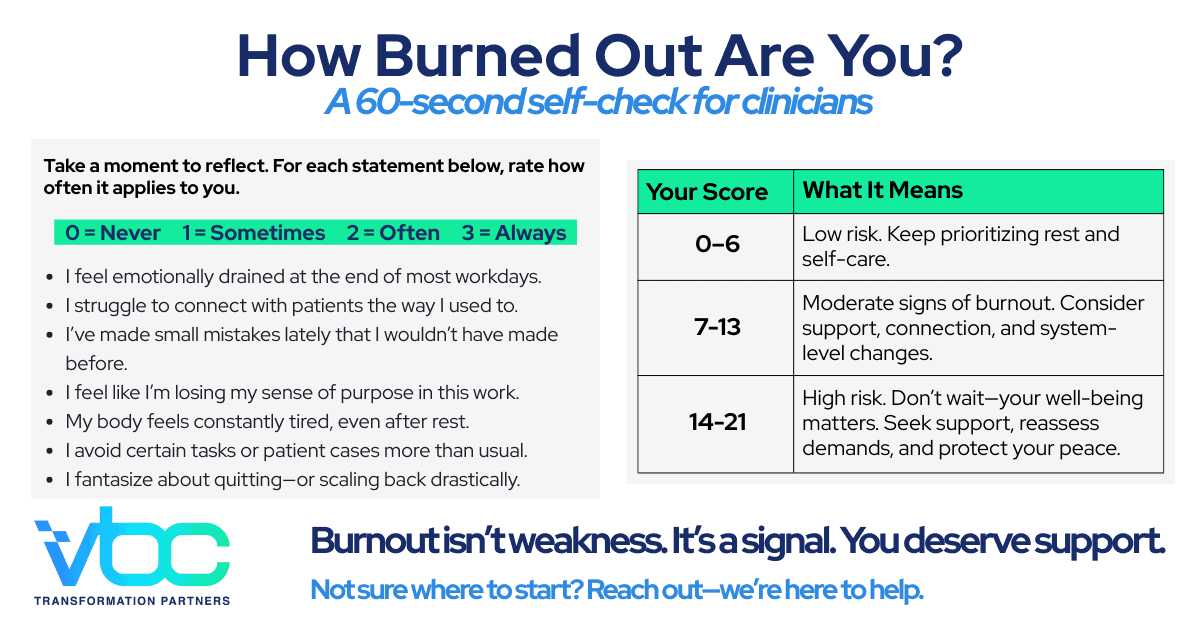
How Burned Out Are You? Self-Assessment Quiz
The Ripple Effect of Burnout
Burnout doesn’t stay isolated. It radiates outward, affecting far more than just the physician feeling it. Patients notice—even when nothing is said. Care teams absorb the weight, picking up slack, covering shifts, navigating tension that didn’t used to be there. Systems lose not just labor, but leadership—because when experienced clinicians begin to detach or leave, they take institutional knowledge and trust with them.
Behind the numbers—higher turnover, increased error rates, declining patient satisfaction—is something harder to measure: the erosion of presence. A physician going through the motions may still be technically effective, but the relational spark—the thing that makes healing personal—is dimmed. That absence has a cost.
When physicians are burned out, patients can feel it—whether or not they know the term. They sense the disconnect, the shortened fuse, the lack of presence. It’s not just perception: research links burnout with higher rates of medical errors, poorer patient satisfaction, and an increase in malpractice claims. Entire care teams absorb the strain, shouldering more as one of their own quietly fades. Administrative leaders feel it in turnover rates and recruitment costs—often upwards of $500,000 to $1 million per physician lost (AMA, 2025; AHRQ, 2023).
More than anything, burnout robs us of something sacred: the joy and connection that brought so many clinicians into medicine in the first place. It turns purpose into performance, healing into hurry. It does so slowly enough that we often don’t notice until something breaks.
What Drives Burnout? The Five Core Causes
Burnout doesn’t come out of nowhere. It has origins—deep ones. Every sigh at the end of a shift, every moment of doubt, every late-night charting session—all trace back to patterns that are as predictable as they are painful. These aren’t random stressors. They’re embedded in the way healthcare is structured, delivered, and experienced. If we want to do more than treat symptoms, we have to name the causes.
Because until we name them, we keep asking physicians to stay resilient in conditions that chip away at their humanity. We keep pouring energy into retention while ignoring the deeper reasons so many are walking away—not just from jobs but from parts of themselves.
Here are five of the most consistent forces behind physician burnout, drawn from both research and lived experience:
- Practice structure: Chaotic environments, inadequate time per patient, and relentless documentation demands increase stress while reducing clinical connection (AHRQ, 2023).
- Loss of autonomy: Physicians are often held accountable for outcomes they have little control over, with standardized workflows that strip away decision-making power (AMA, 2025a; AMA, 2025b).
- Regulatory overload: Misinterpretations of regulations or myth-based policies—like needing to sign every page of a home health plan—waste time and energy.
- Poor leadership alignment: When leaders don’t share values or communicate clearly, disconnection deepens. Studies show a direct link between supervisor quality and physician burnout (Drummond, 2015).
- No time to recharge: Without time or support to rest, connect, or process emotional strain, physicians burn through their reserves—and keep going on empty (Drummond, 2016; AMA, 2018).
What Healing Looks Like: Autonomy, Alignment, and Support
At VBC Transformation Partners, we believe physician burnout isn’t a personal failure—it’s a system-level warning sign. We also know that warning can be transformed into an opportunity.
By restoring autonomy and simplifying the path to value-based care, we help physicians shift from reactive survival to purposeful leadership. Our physician-led approach supports clinical teams in practicing at the top of their licenses—without the constant burden of inefficiency and misaligned incentives.
With tech-enabled tools, tailored transformation models, and data-driven strategies, our work has helped practices:
- Increase revenue while reducing burnout
- Cut operational costs without compromising care
- Improve quality scores while restoring work-life balance
- Reduce staff turnover and boost morale across care teams
You didn’t go into medicine to chase metrics or survive endless inbox messages. You did it to care. We’re here to help you reclaim that.
Let’s Lead Forward, Together
The early signs of physician burnout are a call to act—on behalf of your patients, your teams, and yourself. Whether you're a physician ready for change or a leader seeking systemic improvement, we’re ready to walk with you.
Transformation isn’t just strategy—it’s support. You bring the vision. We’ll help it land.