







New Medicare Advantage rate hikes spotlight the urgent need for physician pay reform—but also open a path to sustainability for those ready to pivot.
In the wake of major Medicare Advantage rate hikes, many physicians are asking a tough question: Where do we go from here? Another year, another pay cut. Another blow to those doing more with less—holding the system together with duct tape and dedication, while watching their profession become less sustainable by the day.
That’s the message many physicians received when CMS released its 2025 proposed Medicare Physician Fee Schedule (PFS), which includes a 2.8% reimbursement reduction—the fifth consecutive annual decrease (AMA). While the cost of running a practice is projected to rise 3.6% next year, the value of physician labor under Medicare continues to decline. In fact, when adjusted for inflation, physician pay has dropped nearly 29% since 2001 (AMA).
This rate hike doesn't just reflect a policy shift—it’s also a signal that there’s real opportunity for providers who are ready to partner more directly with MA plans and take on value-based arrangements.
For many small practices, the math doesn’t just strain the bottom line—it shatters stability. It means seeing more patients, doing more paperwork, and still lying awake at night wondering how to make payroll.
At the same time, CMS finalized a 5.06% Medicare Advantage rate hike for Medicare Advantage (MA) plans for 2026—up from an already generous 2.23% proposed in January. The agency cited updated data from Medicare Fee-for-Service (FFS) expenditures to justify the higher effective growth rate (CMS, CY 2026 Medicare Advantage Rate Announcement).
This divergence highlights a broader shift: the latest Medicare Advantage rate hikes signal CMS’s clear intent to shift away from FFS and toward value-based care models like MA and ACO REACH. For many physicians—especially those still tethered to traditional FFS—this shift feels more like abandonment than innovation. For some, the shift isn’t just frustrating—it feels existential.
What Medicare Advantage Rate Hikes Mean for Small and Mid-Sized Practices
For small and mid-sized groups already stretched thin by staffing shortages, inflation, and growing administrative burdens, these policy shifts are more than numbers—they’re survival issues.
The financial pressure is especially acute for rural practices and solo providers who serve Medicare populations but lack the scale to absorb reimbursement volatility. With private insurers often pegging rates to the Medicare fee schedule, declining FFS rates ripple beyond Medicare into the entire payer mix (AMA).
If these groups cannot pivot toward prospective payments—or forge strategic partnerships with MA plans that allow them to share risk—they may face service cutbacks, staff layoffs, or even closures.
Why Medicare Advantage Rate Hikes Highlight the Broken Fee-For-Service Model
The growing gap between rising Medicare Advantage payments and stagnant—or shrinking—physician reimbursement under FFS makes one thing painfully clear: the FFS model is no longer sustainable. As Medicare Advantage becomes the preferred pathway for CMS investment, FFS-aligned providers are left navigating outdated systems that reward volume over value and offer little protection against inflation or rising operational costs.
Let’s be clear: transitioning away from FFS isn’t simple—but it’s possible, and it’s worth it—with the right partner.
- The MIPS Mess – The current Merit-Based Incentive Payment System (MIPS) is unpopular, and CMS’ proposed replacement—Value Pathways—has yet to win over providers (KFF Health News).
- Downside Risk is Intimidating – Many physicians worry about the financial implications of taking on risk, especially without robust data systems or experienced partners.
- ACO Limitations – Some independent physicians have joined ACOs hoping for stability, only to find lackluster performance, opaque metrics, or poor support for operational improvement.
- Administrative Complexity – Documentation requirements, new quality metrics, and shifting benchmarks make the idea of “practicing at the top of your license” feel increasingly out of reach.
We see you. You didn't go into medicine to learn risk-sharing formulas or chase shifting quality metrics. You did it to care for people. Now you're being asked to survive in a system that doesn't seem to care for you. That’s why this next step isn’t just about strategy—it’s about reclaiming the future of your practice, your purpose, and your peace of mind.
A Better Path Forward: Strategic Transition, Physician-Led
At VBC Transformation Partners, we hear these concerns every day—and we’ve lived them too. Founded and led by physicians, we believe that the key to thriving in this moment isn’t brute-force adaptation, but a physician-led transformation rooted in strategy, sustainability, and real-world care delivery.
We help practices move from reactive survival to proactive success, with flexible models that fit your people, your pace, and your path.
We partner with you to:
- Transition from FFS to VBC with clear strategies, personalized roadmaps, and realistic timelines—minimizing disruption and maximizing alignment.
- Strengthen both clinical and financial performance, as we did for one healthcare organization that achieved $16M in medical cost savings and doubled chronic care enrollment in three years.
- Structure Medicare Advantage partnerships that help you move from passive recipient to active participant in shared savings and growth opportunities.
- Reduce burnout and restore autonomy, with streamlined operations that let your clinicians practice at the top of their license—not at the bottom of a spreadsheet.
- Boost compliance and quality scores, including measurable gains in Medicare Stars performance and risk contract outcomes.
- Design scalable pilot programs that prove impact before you scale—no one-size-fits-all playbooks, just what works for your world.
We don’t just offer support—we walk beside you as your transformation partner. With clinical credibility, operational expertise, and a fierce commitment to people, we help you build a future that’s both human and high-performing.
Strategic Moves Physicians Can Make Amid Medicare Advantage Rate Hikes
Adapting to this new reality doesn’t mean navigating it alone. At VBC Transformation Partners, we help practices turn uncertainty into action—with strategic, physician-led support at every step.
Here’s where we start together:
- Evaluate Your ACO Performance — Not all ACOs are created equal. If yours isn’t delivering results or transparency, we’ll help you assess alignment, negotiate better terms, or explore more viable alternatives.
- Explore Partnerships with MA Plans and Prospective Payment Model — Whether it’s entering into capitation arrangements, delegated risk models, or enhanced contracts with local MA plans, we help providers understand their options and structure agreements that align incentives—and unlock shared savings.
- Invest in Population Health — Proactive care is powerful—but hard to scale alone. We help you design and implement population health strategies that improve outcomes, reduce costs, and boost performance in value-based programs.
- Partner with Experienced VBC Advisors — You don’t need another vendor—you need a partner. We bring the clinical insight, operational know-how, and change management support that helps practices not just survive the shift—but lead it.
Don’t Let This Moment Pass You By
We are at an inflection point. CMS has made its intentions clear: Medicare is moving away from Fee-for-Service—and those who wait too long to adapt may find themselves without a seat at the table.
Physicians deserve better than what the current system offers, but while we advocate for necessary reform, we must also equip practices with the tools they need to thrive in what comes next.
If you're ready to make the leap from uncertainty to sustainability, we’re ready to help. Your practice deserves more than survival. Let’s build a path to sustainability—together.
Not sure if value-based care is worth it?
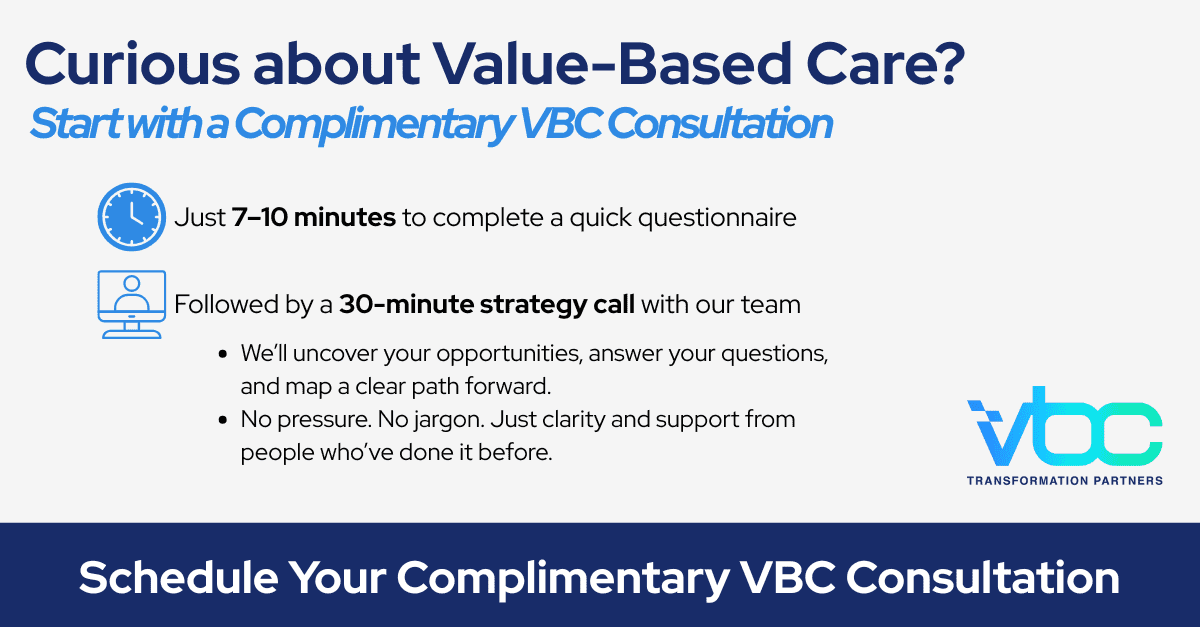
Start with a conversation—no pressure, no commitment. Just 7–10 minutes to complete a quick questionnaire and a 30-minute call to explore what’s possible for your practice.
If you're ready to stop surviving and start transforming, schedule your Complimentary VBC Consultation.