





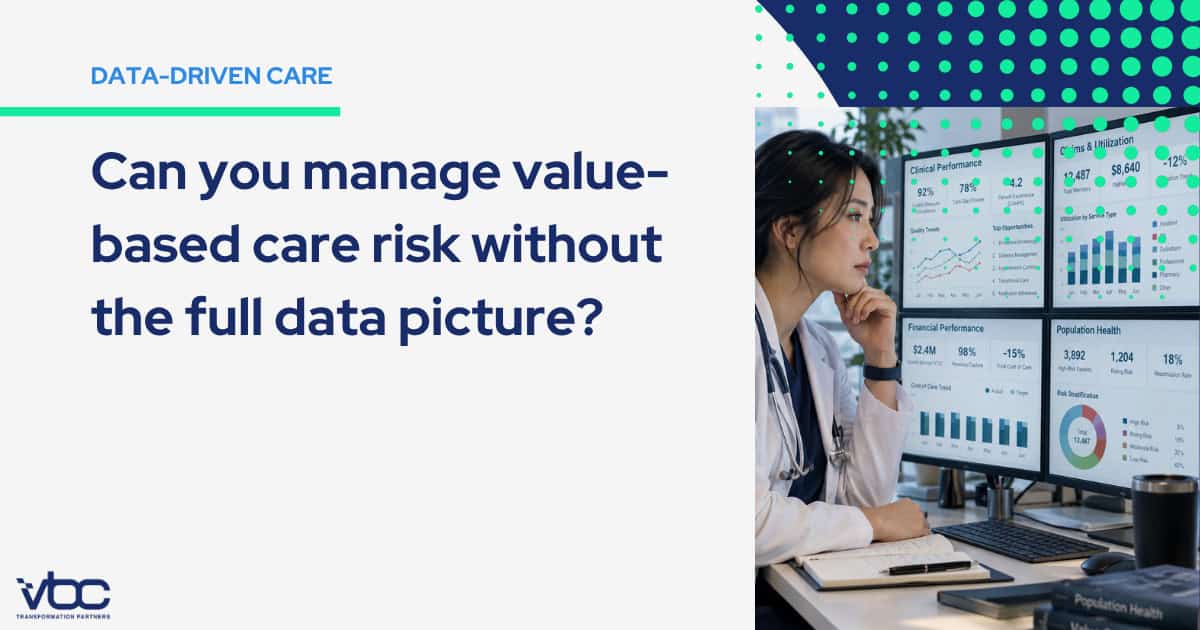
Value-based care continues to expand financial accountability for providers, but many organizations are being asked to manage cost, quality, utilization, and patient outcomes without access to the complete data picture.
Clinical data tells providers what happens inside their practices. Claims, utilization, attribution, and network data reveal much of what happens outside them. When those sources remain disconnected, providers struggle to see where patients receive care, what services they use, where costs are accumulating, and which interventions could change their trajectory.
That creates a fundamental problem: you cannot effectively manage financial risk without visibility into what is driving it.
The Data Gaps Behind VBC Performance
EHRs provide critical clinical information, but they rarely capture a patient's the patient population’s entire healthcare journey.
A patient may be hospitalized in another health system without the primary care team receiving timely information. A specialist may change a medication without notifying the PCP. An emergency department visit, imaging study, post-acute stay, or home health referral may occur outside the practice's systems.
Claims and other external data help fill those gaps by providing visibility into diagnoses, pharmacy utilization, procedures, hospitalizations, post-acute care, and other services.
When clinical, financial, and utilization data come together, providers have a much stronger foundation for managing populations and financial risk.
Without that visibility, organizations may struggle to:
- Identify high-risk patients before preventable utilization occurs
- Coordinate care following hospitalizations, ED visits, and specialty care
- Identify leakage and utilization patterns that increase total cost of care
- Close documentation and care gaps that affect quality and risk-adjusted performance
- Understand contract performance and lost revenue opportunities
- Negotiate effectively with payers using reliable performance data
These are not simply data problems. They become operational, clinical, and financial problems.
More Risk Makes Visibility More Important
The problem becomes more consequential as organizations move deeper into value-based arrangements.
Practices may be accountable for outcomes across an attributed population while having detailed claims information for only part of that population. Yet they still must make decisions about staffing, technology, care management, network strategy, and workflow investments.
Incomplete information can also make it difficult to determine why performance is falling short. Is the problem avoidable utilization? Network leakage? Documentation? Patient complexity? Contract terms? Care transitions?
Without sufficient visibility, organizations can invest significant resources without knowing whether they are addressing the right problem.
Better Payer-Provider Data Sharing Is Part of the Solution
Payers and providers share an interest in reducing avoidable utilization, improving outcomes, and controlling total cost of care. Better information exchange can make those goals easier to achieve.
Masked claims data can protect proprietary pricing while supporting outcome analysis. Trusted third-party intermediaries can facilitate exchange. Aggregated cost and utilization analytics can provide actionable information without exposing unnecessary contractual details.
Greater interoperability and payer-provider data sharing should remain an industry priority, but providers cannot wait for a perfect data environment before improving performance.
Start With the Data You Have
The most useful question may not be, Do we have all the data we need? Instead, ask: What can our existing data tell us, and where are our most important blind spots?
Which contracts are actually producing value? Where is avoidable utilization occurring? Which patients require intervention now? Where are documentation gaps affecting revenue and quality? Which providers or referral patterns are driving variation?
Those questions connect data directly to operational decisions.
At VBC Transformation Partners, we help independent practices, ACOs, IPAs, and CINs build that capability through our VBC Operating System.
Our approach works across clinical, operational, and financial data sources, including EHRs, claims, scheduling, care management, HIE and attribution data, labs, radiology, and SDOH data. The objective isn't another dashboard. It's getting useful information into the workflows and decisions that determine performance.
Depending on an organization's needs, that can include:
- VBC Enterprise Diagnostic to identify readiness gaps, quantify opportunities, and prioritize investments based on potential ROI.
- Contract Performance & Revenue Analysis to evaluate payer performance, identify lost revenue, model opportunities, and strengthen contract decisions.
- Clinical Documentation, Risk Adjustment, Quality & Patient Experience to improve documentation accuracy, close care gaps, and connect clinical performance to financial risk.
- Population Health Navigation & Care Coordination to identify high-risk patients earlier and coordinate interventions that reduce avoidable utilization.
- Network Navigator to identify leakage, referral patterns, provider variation, coverage gaps, and opportunities to improve network performance.
The technology matters, but technology alone does not create transformation. Data has to reach the people who can act on it while there is still time to change an outcome.
Turn Visibility Into Action
Providers should continue pushing for better payer-provider data sharing. Greater transparency and interoperability can improve care coordination, strengthen contract alignment, and give organizations a more complete picture of the populations for which they are accountable.
At the same time, organizations can strengthen the infrastructure that turns the data available today into better decisions.
Because success in value-based care increasingly depends not simply on having more data, but on knowing what is happening, why it is happening, and what to do next.
Ready to strengthen your VBC data strategy?
Schedule a complimentary conversation to see how our VBC Operating System can support measurable clinical, operational, and financial performance.